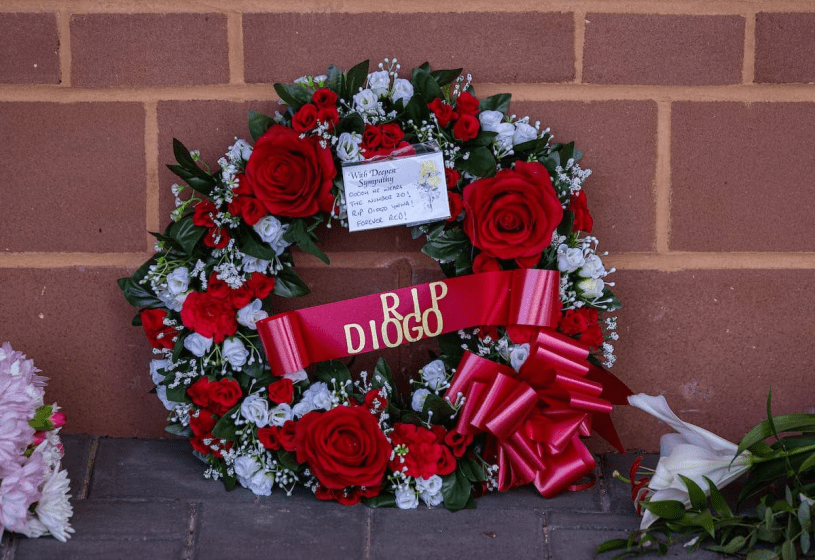
Firstly, there’s simply no other way to start this weeks article. Never more are we are reminded of our absolute mortality and of the gift of life, than when someone leaves. Portuguese father, husband and footballer Diogo Jota, died in a car crash with his brother Andre Silva earlier this week. Jota had only a couple of weeks ago finished a season where he won the Premier League with his club Liverpool, and the Nations League with his country Portugal. He leaves behind three children, he was just 28 years old.
The Earth has a brutal way of continuing to spin regardless of the plight of it’s occupants, and those of us left behind have no other option than to spin with it.
+ + +
There’s nothing like a good fight….
I’m a sports nut, which is probably apparent by the fact I’ve created a blog to regale my readers with stories all about it. I’ll play anything, and watch whatever I can when I have the spare time. The drama, the stories, the teamwork, the individual athletic prowess, I love it all. Throwing and catching or kicking and passing or hitting a ball were all staples of my upbringing. I’d love to provide some sort of eureka moment where as a child something drew me towards it, but I simply can’t remember ever not enjoying playing, watching or talking about sports.
Coming up in the 1990’s was quite the time for a kiwi sports fan: the All Blacks, Michael Jordan, Ronaldo Fenomeno, the 96 Olympics, the 98 World Cup. The Warriors came into existence in 1995, Danyon Loader won his golds in 1996, and Christian Cullen was scoring length of the field tries for fun in 1997. I loved it all, and I have had various spells of fascination with just about every sport there is. That fascination has stayed with me to this very day, I’ll never be too old to get hyped for a sporting event and as far as sporting events go……..
There’s nothing like a good fight….
Last Sunday afternoon, some of the boys came round (with the absence of a couple who were definitely missed) and watched UFC 317. It was one of the best cards for quite some time and provided fireworks from the off. The first fight was a regulation three round decision banger, Payton Talbott edging out Felipe Lima. In the third, a star was born, with Burmese 23 year old Joshua Van securing an epic knockdown seconds before the end of his war with the ever pouty Brandon Royval to edge the scorecards and probably secure the next shot at the flyweight belt in the process.
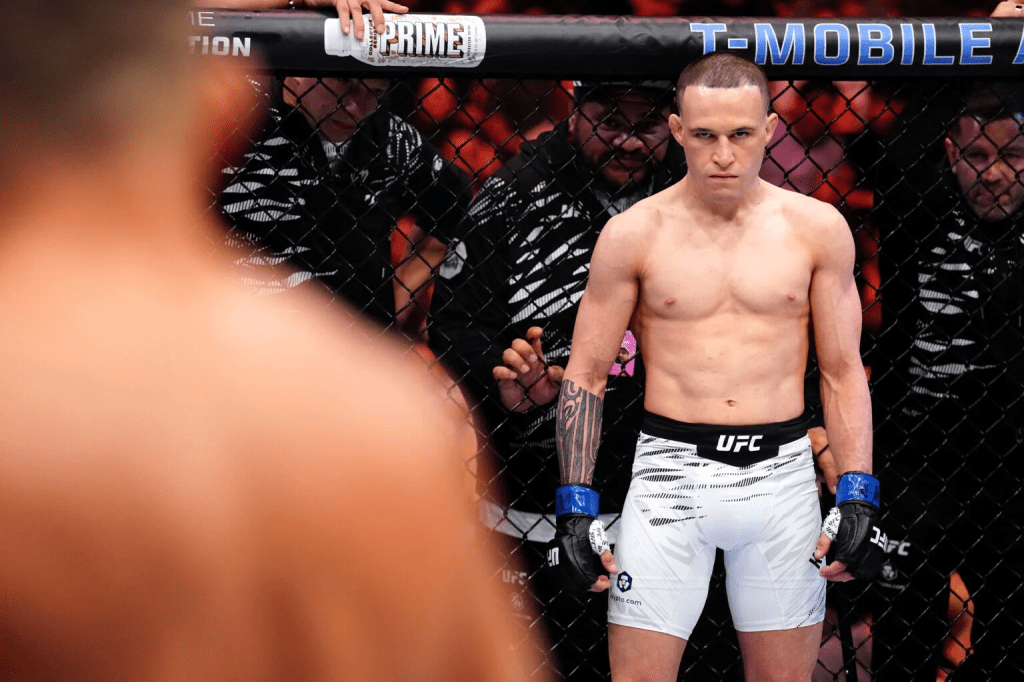
In the co-main event Brazilian Alexandre Pantoja was a class above challenger Kai Kara-France. Our Kiwi hope was coming off a sensational knockout of Steve Erceg in Perth last year, and had a lot of hype behind him going in. A partnership with Betcha advertised specials to place a wager on the kiwi, and his walkout and his extended scowl promised fireworks. But he was on the back foot from the first second of the fight. By 20 seconds in it was clear he was a fish out of water. He managed to hang in there for the better part of two and a half rounds before what felt like an inevitable rear naked choke from the champion to finish things off.
Earlier in the evening, Beneil Dariush entered the Octagon for the first time in two years, following the violent pummeling he received in his last fight. In the dying seconds of the first round he was in the wars again, opponent Renato Moicano landing one square on the American’s chin. He was in big trouble, but survived and fought smartly to win the last two rounds and with them the fight. At the time I thought it a rare win for us mid thirty somethings against father time, until I learned that both fighters were the same age. My yearning for a victory of old over new would have to wait to the much anticipated main event. Brazilian legend Charles Oliveira vs Georgian sensation Ilia Topuria for the lightweight title.
Oliveira is probably the most widely adored fighter on the UFC roster today. A graduate of Brazil’s notorious favella’s, he is a pillar of kindness, likability and humility outside of the octagon. Inside it he is a ferocious assassin, possessing a rare relentless energy and comfort in the dark places. Despite the fact his fights are often bloodbath’s, Oliveira is no mere entertainer, and possesses an elite array of all around skill that allowed him to hold the Lightweight title from mid 2021 to late 2022. But at 35 years old, future chances of championship glory are not guaranteed, and this felt like a last chance for us to see our favourite fighter on top of the world again.
Standing in his way, the Georgian Topuria is the antithesis of Oliveira. Far from the beloved fan favourite, his brash persona and permanent smug like grin contribute to a personality far removed from the Brazilian. As a fighter, he is absolute box office, possessing a rare natural power in his hands. Alexander Volkonovski and Max Holloway had been put to sleep in his last two fights. He was the current Featherweight champion of the world, but had vacated his belt to come up a weight class to try and add the Lightweight title to his resume.
The storylines for the fight wrote themselves. A classic crossroads of eras old and new, the deadliest grappling vs the heaviest hands, the beloved fan favourite legend vs the polarizing ascending star. It was one of the most highly anticipated fights in recent memory and the start of the first round showed glimpses of the high level matchup that we were looking forward to. But just like that it was over, Topuria’s concrete fists proved too much for yet another legend of the sport, Oliveira was knocked unconscious just 2 minutes and 27 seconds into the fight. The legend fell, the star continued his ascent.
It is incredible how inevitable something can seem in hindsight. An eerie foreshadowing of the outcome occurred when the Brazilian embraced his family on the way into the octagon, they were to a person in tears. They knew. Topuria had called a first round knockout before the fight had begun, he knew. The odds makers had Topuria as a better than 4-1 favourite, they knew. But us fight fans with our wide eyes and hopeful minds, couldn’t give up hope that our favourite veteran would rage against the dying of the light one last time.

As much as it hurt to see Oliveira fall, if we dwell on the end of one legend, we fail to see the beginning of another right in front of our very eyes and the main event of UFC 317 gave us exactly that. Ilia Topuria is a phenomenon. No-one has ever had a run to the top like it. Volkanovski, Holloway and Oliveira are three of the greatest fighters of all time, and Topuria has nonchalantly sent them all to beddy-byes in consecutive fights. His power and aura of invincibility are reminiscent of a prime Mike Tyson, and it will be another seven years before he is as old as Oliveira is now. But universal acceptance will take time.
It was a sensational moment seeing Topuria run over Oliveira like that and for once I was grateful that my sentimentality for the past hero didn’t cloud my vision to the point that I couldn’t enjoy what was in front of me. So often we miss the peak of the career of a great because as fans we are stuck in the yesteryears, trying to relive old glories, putting a legend past their prime on a pedestal.
This is the classic treadmill ride of sports fandom. An up and coming athlete divides opinion, hated and loved in equal measure. The up and comer defeats the current beloved champion. The up and comer becomes the new champion, but it takes us a while for us to accept their new found position, as we long for the old champion. We start to finally appreciate the new champion, just as a new up and comer arrives, dividing opinion, hated and loved in equal measure. The new up and comer becomes the new new champion, we long for the old new champion and on and on it goes. It’s a cycle that leaves us running at the same speed as the world, but always maintaining a half yard distance behind it.
There is so much hate in sporting fandom, that so many magical moments aren’t appreciated as they should be. Topuria is on top, and in his prime right now, we should enjoy him while we can. Fail to do this and in a few years we’ll be playing catch-up again, hoping that the old Georgian could give us one last victory, wishing we had enjoyed his magical run. Unfortunately there will be many who will find any reason to downplay his success, and they will cling onto whatever reasoning they have like barnacles to a rusty old boat.
+ + +
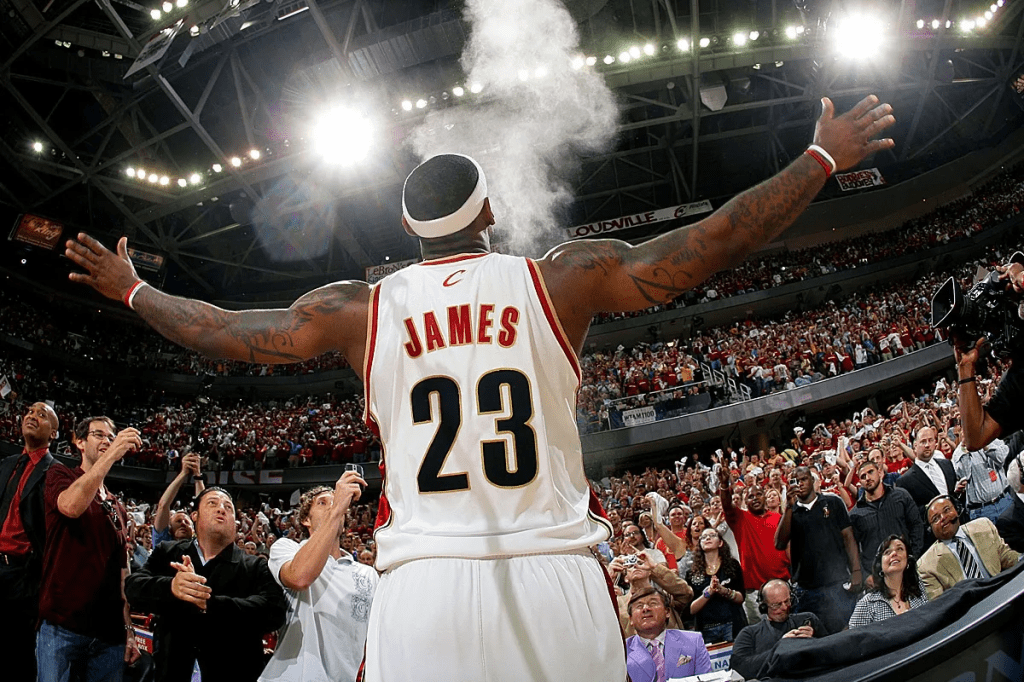
LeBron James was catapulted into superstardom when signing a $90 million US contract while still at high school in 2003. He was the number one overall pick in that years NBA draft, and has gone on to win 4 Championships, 4 MVP awards, 4 Finals MVP awards, 3 Olympic gold medals, and break the all time record for most points in the league’s history. He is arguably the greatest player in the history of the game of basketball, and at the age of 40 he is still playing to an elite level. His combination of all-around skillset, elite performance and longevity is unmatched, but as he enters his 23rd season the path to universal adoration is one he is still walking.
Comment sections (not exactly the greatest example of humanity) on LeBron posts will always feature the inevitable arguments from those who will find any angle they can to downplay his achievements, usually accompanied by one of the many pejorative re-arrangements of the man’s name (‘LeFraud’ and ‘LeFlop’ seem to be the most popular). The most commonly used stick used to beat James comes in the shape of a man who’s shadow continues to hover over the league, Michael Jordan. The Jordan vs LeBron debate has been a constant background track to the league ever since the latter started to challenge the former for the much coveted title of GOAT.
GOAT to the uninformed is an acronym for ‘greatest of all time’ and has become a part of the popular sporting lexicon in the past decade. The term has become more and more common, to the point where it has turned into it’s own word, it’s history as an acronym forgotten, sometimes even replaced by an emoji of the farm animal with whom it shares a name. It is the go to term to describe the best player of any given sport but it’s scope can be as broad or specific as you like. It’s the ultimate prize that any athlete can attain, but it isn’t actually a prize at all, it’s a concept, and the GOAT discussions are only ever that, a discussion.
There is no defined metric to compare an athlete who competed in one era, to one who competed in another. Without the benefit of them actually facing each-other in a competition in their prime there’s just no definitive way to know, but that doesn’t stop us from trying to find out. It is the perfect encapsulation of our constant need to rank and compare. In it’s essence the discussion should really be a celebration of sporting excellence but worship for one GOAT contender, nearly always comes with an equal disdain for another, and the basketball GOAT debate is no different.
Although there are some alternative opinions, the majority of basketball fans believe that the greatest to ever play the game is one of Jordan or James, with many having a seemingly inbuilt inability to appreciate both. The debate has intensified as LeBron has kept on going and continued to justify his claim to a spot on the same pedestal that most 90’s loyalists believe Jordan belongs on alone.
Despite the hard core absolutists on both ends of the Jordan-LeBron spectrum that would have you believe one absolutely shits on the other, the gap between them continues to close. Despite being able to see that, I am an unapologetic Jordan loyalist. His career was a movie and I could repeat any of the rehearsed reasons for feeling this way, his six titles for one team, winning the the last with arguably the most famous shot in the game’s history, but there’s probably a more simple reason for why I see him as greater than LeBron. When I was born.
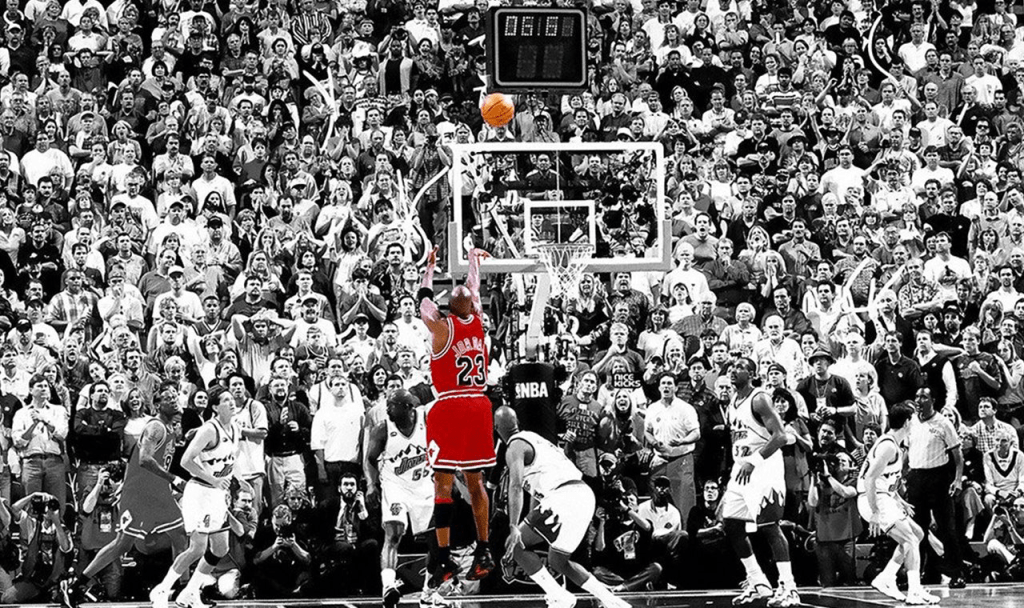
In the 1990’s the name Michael Jordan carried an almost mythical aura. I remember talking about him in basic seven year old school conversation. I remember thinking how odd it was when some contrarian didn’t like him. I remember watching Space Jam at a friends birthday in 1996, it was one of the most exciting days of my life to that point. I remember basketball cards being everywhere. I remember Scottie Pippen, Dennis Rodman, Steve Kerr and Ron Harper. I remember no fewer than 4 boys in our year 3 class wearing a Chicago Bulls hat to school, I was one of them.
Jordan’s career with the Bulls ended in 1998 when I was just 8 years old, LeBron’s started only 5 years later. If I was simply born a few years later I would’ve missed it all and had a completely different experience in my formative years. Of course every rule has it’s exceptions, but it is common for fans to favour players from a generation that they reminisce upon the most fondly. For the most part fans who came up in the nineties favour Jordan, those who came up in the thousands and tens favour LeBron, some caught a generation in between might favour the late great Kobe Bryant.
Father time will catch up with LeBron soon enough, and his retirement within the next season or two is almost certain, by which point he will have been a household name for the better part of a quarter century. He’s a legend, but some will still refuse to see it, until it’s too late. Soon enough there will be a new all time great contender, a new household name, and there will be an inevitable hoard of LeBron loyalists, stuck in the mid 2020’s refusing to acknowledge the passing of the torch. Just like the Jordan fans they continue to spar with. Either way, recent or not, both fan groups will be living in the past.
What is it about us that makes us so attached to the mirage of past glories while failing to see the gold in front of our very eyes? That’s far too deep a question for me to definitively answer, but it is interesting how often this happens in sport. How many golf fans wanted Tiger Woods to lose every tournament in the early thousands, only to binge watch his highlights on youtube today? But why? I listened to an episode of the podcast Diary of a CEO a couple of days ago, Buddhist monk Gelong Thubten was the guest and he made an incredible point that I’d never really thought of: we as human beings are addicted to our own thoughts.
We do think alot, and the vast majority of our thoughts are dictated by the past, whether reminisced or reimagined. Even our thoughts of the future are a prediction based upon our interpretation of past events. Thinking too much makes life incredibly stressful, and we have a society that thinks far too much. We’ve become a people constantly stuck and constantly searching for answers to questions that have none (Who is the GOAT!!!!!!). We need to let go, breath and embrace the present, stop regretting or idealizing the past, otherwise we’ll fail to enjoy what’s right in front of us and turn the present into a future regret.

This really resonated with me. At first it seems almost ridiculous, what do you mean ‘addicted to our own thoughts’, how can we not be? We’re thinking all the time! ‘I should have said this’, ‘I should have done that’, ‘was that look they gave me indicative of their undying hatred for my existence, or were they just hungry,’ we’re constantly thinking about and reliving the past. The reality of adulthood long since dashed our hopes of a life of complete freedom, instead it is dictated by an endless enslavement to our own thoughts.
When we were kids, or whenever we truly last felt like a kid we didn’t think as much, it is this past that our thoughts are looking for. Like any addiction we crave a cure, and our default treatment is to idealize times where we didn’t think so much. Anything and everything associated with these memories becomes idealized, including our favourite athlete, but all those memories occurred when we were living in the present and returning to the present is the real cure.
Because it is possible to not think as much and appreciate the now, and all of us still experience that sometimes. When we are truly enjoying something, how much thought do we really have? Playing sport is a perfect example of this, when I’m playing a game of football, or having a good day at the golf course (a rare occurrence) I have very little conscious thought outside of the present, most of what I do is completely subconscious. Most importantly of all for a brief time, there is no regret.
The funniest thing about regrets are how circular they are. Many of us regret not doing something or other in the past, that regret will lead us to miss an opportunity in the present. Our missed opportunity in the present will then lead to regret at a future time, leading us to miss another opportunity and on and on it goes.
It’s like the classic treadmill of sporting fandom. But it’s so simple to break the cycle, simply forgetting about one regret in the chain, and capitalizing on one opportunity to enjoy the present moment can put us back in reach of the present. With just a small adjustment we can take full enjoyment of all the wonders that the present has to offer. We just need to get off the treadmill and stop running on the proverbial spot.
+ + +
 NIL-ALL Blog